 Daily missions. Brighter futures.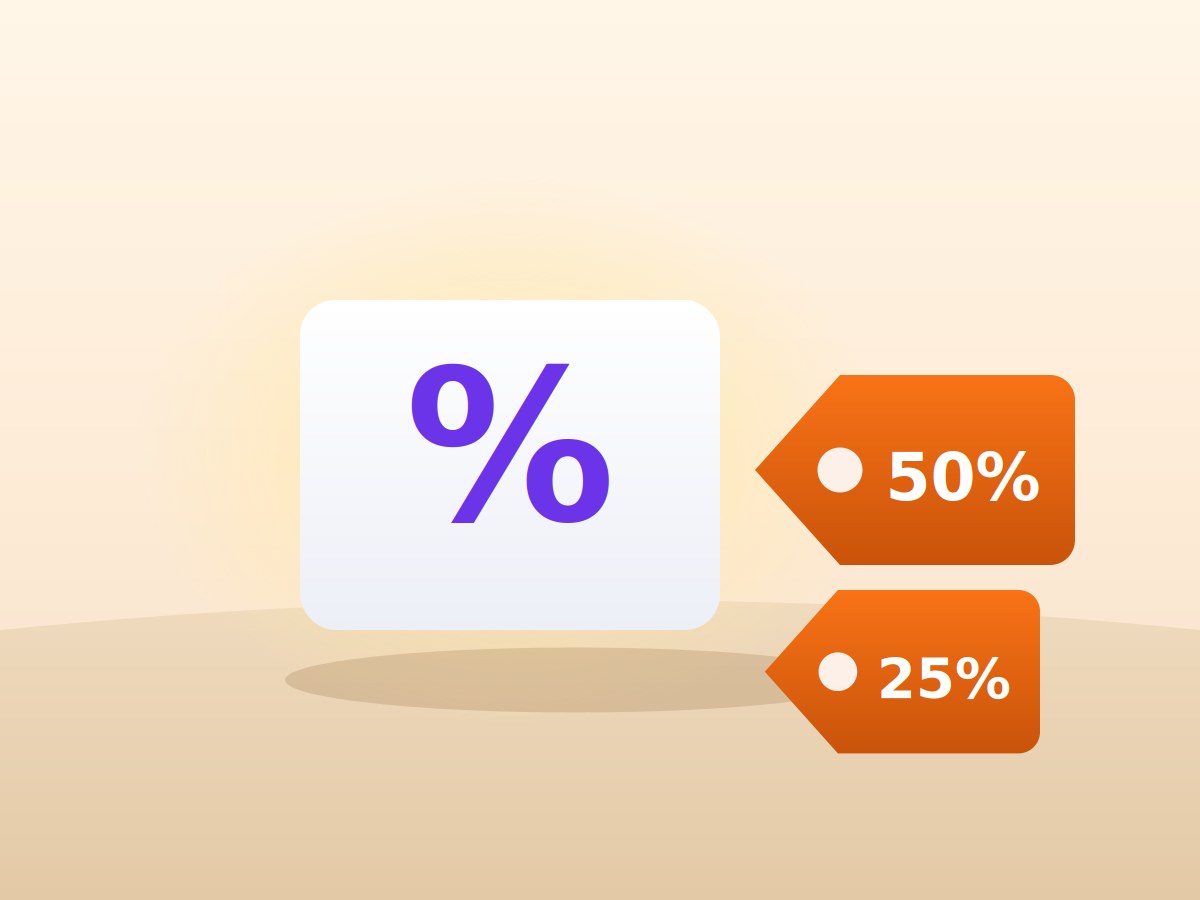
Percent means “out of 100”. Almost everything else follows from that one sentence.
Percentages sound very mathematical. In practice children meet them all day long: sales, battery levels, football statistics, how far a download has got, test scores.
So you're not introducing a new idea. You're attaching a word to something they already understand.
Start with the word itself
Percent means “out of 100”. So 50% is 50 out of 100. 25% is 25 out of 100. 100% is all of it.That's worth saying out loud, because a surprising number of children have done percentage calculations for two years without ever being told what the word means.
Start at £100, then shrink it
Ask: “if you had £100 and I gave you 50% of it, how much would you get?” £50. “What about 25%?” £25. Easy, because the numbers do the explaining.
Now change £100 to £20. Half of £20 is £10 — that's 50%. Half of that again is £5 — that's 25%.
Percentages have stopped being mysterious symbols and become portions of an amount.
Next time something is downloading or charging, point at it:
“It says 75%. Is that nearly done, half done, or just started?”Most children understand percentage intuitively long before they can calculate it. Build on the intuition rather than starting from scratch with a method.
The mistake children often make
Some children learn each percentage calculation as a separate trick without ever grasping what a percentage is. It works right up until the question is phrased differently.
A good test of the difference: ask “could I have 150% of something?”
It's a genuinely interesting question. Yes — 100% is the whole thing, so 150% is one and a half times it. A child who can reason about that understands percentages. A child who has only learned procedures usually says no.
“A £40 game is 50% off. What would you pay?”
Then the important half: “how do you know?”
One child halves £40. Another works out 10% and multiplies. Another just knows that 50% is half. All three are fine — the explanation tells you whether there's an idea underneath or a memorised step.
If they're still stuck
Anchor everything to 10%. Ten per cent of any amount is that amount divided by ten, and almost every other percentage can be built from it: 20% is double, 5% is half, 30% is three lots.
It's a more useful tool than any formula, and it works in a shop without a calculator.
Percentages in the Learning Centre
More worked examples and practice at your child's pace, including percentages of amounts and finding the original amount.
Open the Percentages lessons →Where MindBlaze fits
Once “out of 100” has landed, percentage calculations have something to attach themselves to — which is the difference between remembering a method and being able to work one out.
MindBlaze practises percentages alongside fractions and decimals in short daily challenges, so the connection between them stays live.

Out of a hundred. That's it.