 Daily missions. Brighter futures.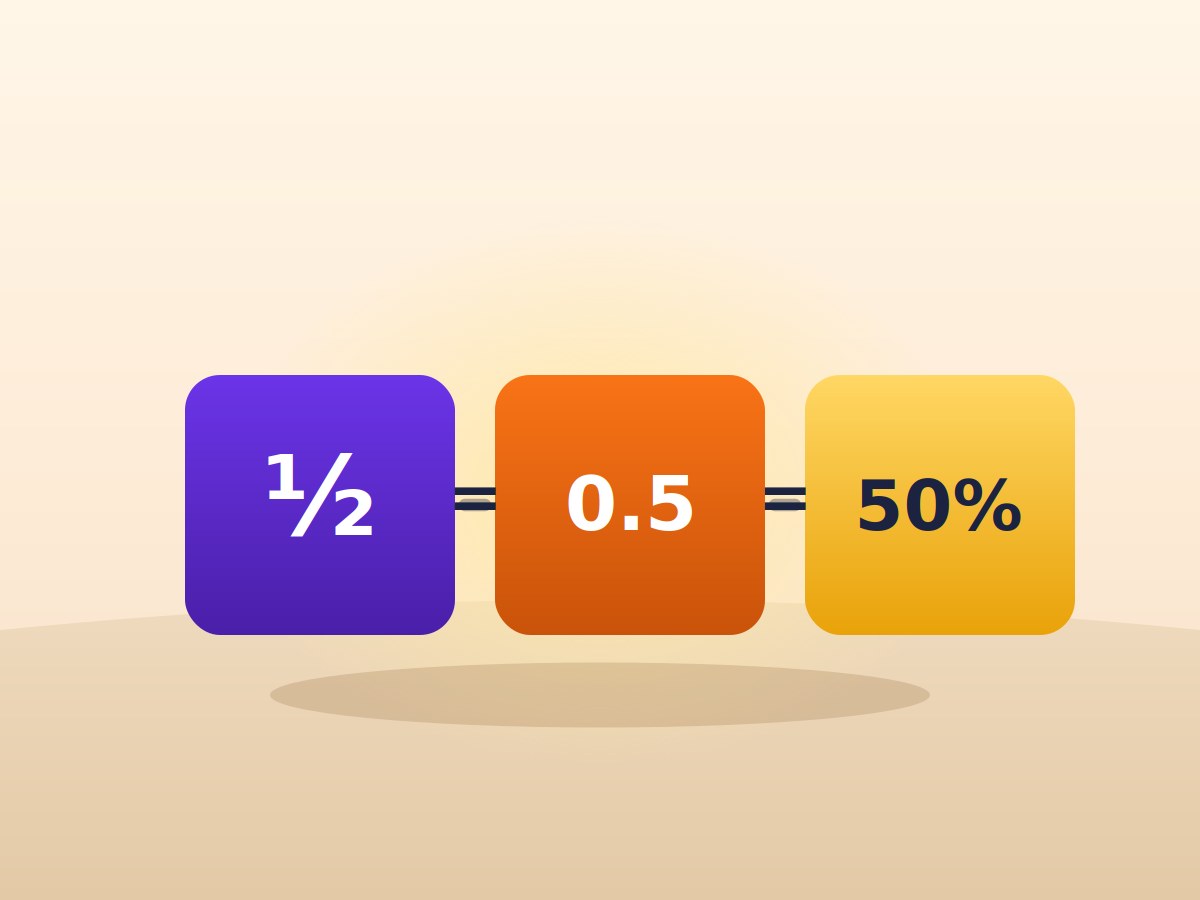
½, 0.5 and 50% are the same amount described three different ways. Nothing about the amount changes — only the language.
Put ½, 0.5 and 50% in front of a child and they can look like three completely unrelated bits of maths, each with its own rules to remember.
They aren't. They're three ways of describing exactly the same amount — and a child who sees that has far less to memorise than one who doesn't.
One chocolate bar, three descriptions
Half a bar of chocolate can be written ½. As a decimal, 0.5. As a percentage, 50%.
The amount of chocolate never changed. Only the way we wrote it down.
Learn three links, not a table
Don't start with a conversion chart. Start with three relationships and make them genuinely solid:
½ = 0.5 = 50%¼ = 0.25 = 25%
¾ = 0.75 = 75%
Almost everything at this level can be reasoned out from those three. A child who knows them cold can work out 12.5% or 0.2 by thinking; a child with a memorised table can only look things up.
Draw a square. Divide it into four equal parts. Colour one in.
Then ask three questions about the same picture: “what fraction is coloured?” (¼) — “what percentage?” (25%) — “what decimal?” (0.25).
One picture. Three answers. That's the whole lesson, and it takes about ninety seconds.
The mistake children often make
They assume each topic needs a brand-new method, so they learn three sets of procedures and keep them in separate boxes.
The fix is a habit rather than a lesson. Whenever one of the three comes up — in homework, in a shop, on a screen — ask:
“Could we write that another way?”“Which is bigger — 0.5 or 40%?”
It looks like a trick question and it isn't. It's just asking whether they can move between the two forms.
If they're stuck, prompt once: “what's 0.5 as a percentage?” Once it's 50% versus 40%, the comparison is obvious — and that is the skill.
Fractions, decimals and percentages
The Learning Centre covers all three separately and then the links between them, which is where most of the marks are won and lost at secondary school.
Open the FDP lessons →Where MindBlaze fits
Moving between fractions, decimals and percentages is something the curriculum expects children to do fluently by the end of Year 6, and it's assumed knowledge from day one of Year 7.
MindBlaze mixes all three in the same daily missions on purpose, so they stay connected rather than becoming three separate memories.

One amount. Three languages.