 Daily missions. Brighter futures.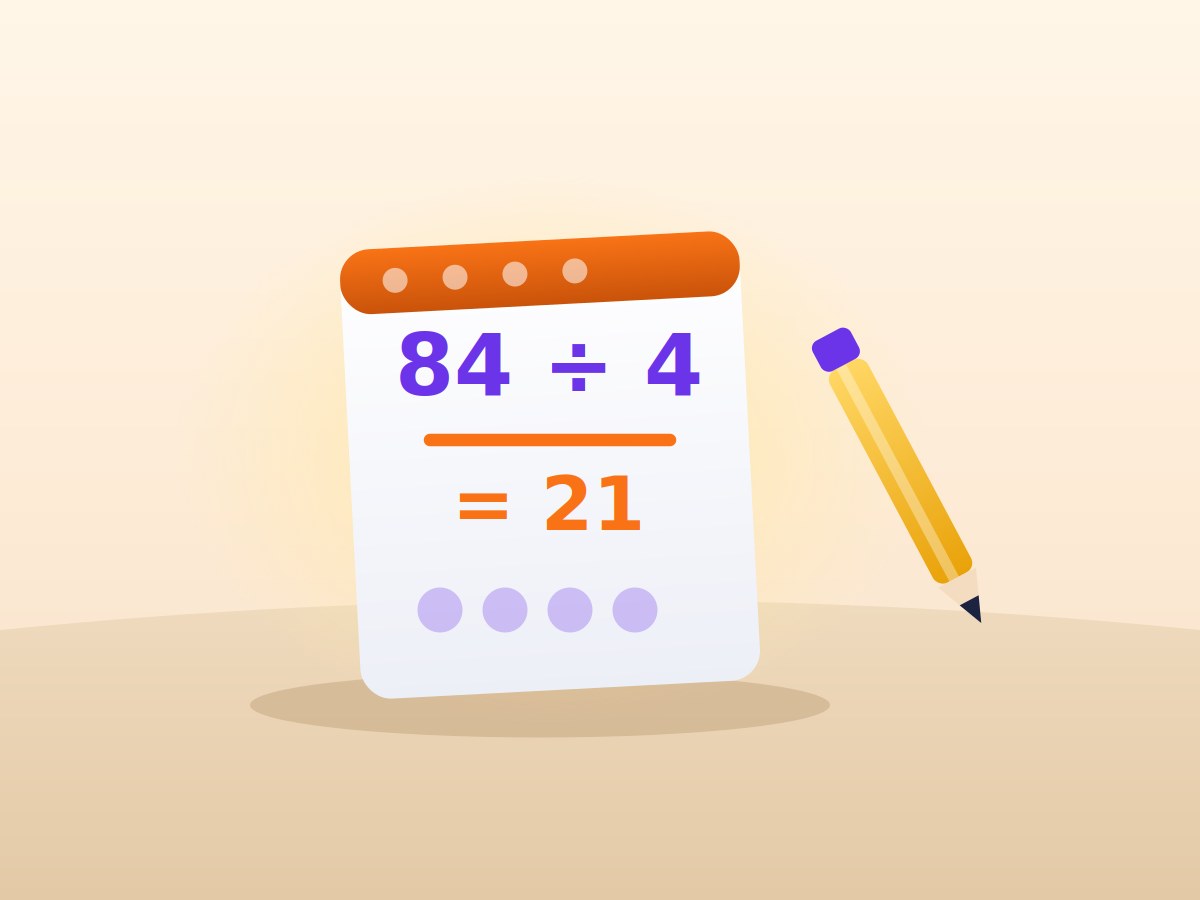
The page looks complicated. The thinking is just a sequence of small decisions.
Long division has a reputation on both sides of the table. Parents look at the layout and think I'm sure we didn't do it like this. Children look at it and see numbers scattered everywhere with no obvious order.
Before you go anywhere near the written method, make sure the idea underneath is solid — because a child who has lost the idea is just following steps and hoping.
What division actually means
84 ÷ 4 means: if you share 84 things equally between four groups, how many end up in each group?That sentence is the calculation. The written method is only a tidy way of doing it when the numbers get too big to picture.
Estimate before you calculate
Don't start with an enormous number. Start with something they can reason about, and ask the question that most children never get asked:
“Roughly what answer are we expecting?”For 84 ÷ 4, around twenty. That estimate isn't a nicety — it's what lets them spot later that an answer of 210 has gone wrong.
One decision at a time
Don't narrate the whole algorithm in one breath. It sounds like a spell.
Ask “how many fours fit into this bit?” Write it. Then move on to the next bit and ask the same question again. That's all the method is — the same small question, repeated, in a tidy layout.
Give them 84 ÷ 4 and ask for an estimate before anything is written down. Then work through it one question at a time, with them holding the pencil.
If they get lost halfway, don't restart — just ask the small question again about the bit they're on.
The mistake children often make
They get so focused on executing the procedure that they stop thinking about the numbers entirely. This is why a child will confidently write that 84 ÷ 4 = 210 and move straight on.
The habit that prevents it is the one from the estimate:
“Does my answer make sense?”“How could you check that answer?”
The answer you're hoping for is multiplication. If 84 ÷ 4 = 21, then 21 × 4 should be 84.
A child who reaches for that check independently understands the relationship between multiplication and division — which matters far more than a tidy layout, and is the thing Year 7 will lean on.
More maths in the Learning Centre
Worked examples at your child's pace across every maths topic — all free to use, and a good place to go next once the idea has landed.
Browse the free maths lessons →Where MindBlaze fits
Year 6 covers formal written division and interpreting remainders, and Year 7 assumes both. Understanding what's happening underneath the method is what makes the difference when the numbers get less friendly.
MindBlaze practises division in short daily bursts and the Learning Centre explains it again whenever it's needed.

Estimate. Then one small decision at a time.