 Daily missions. Brighter futures.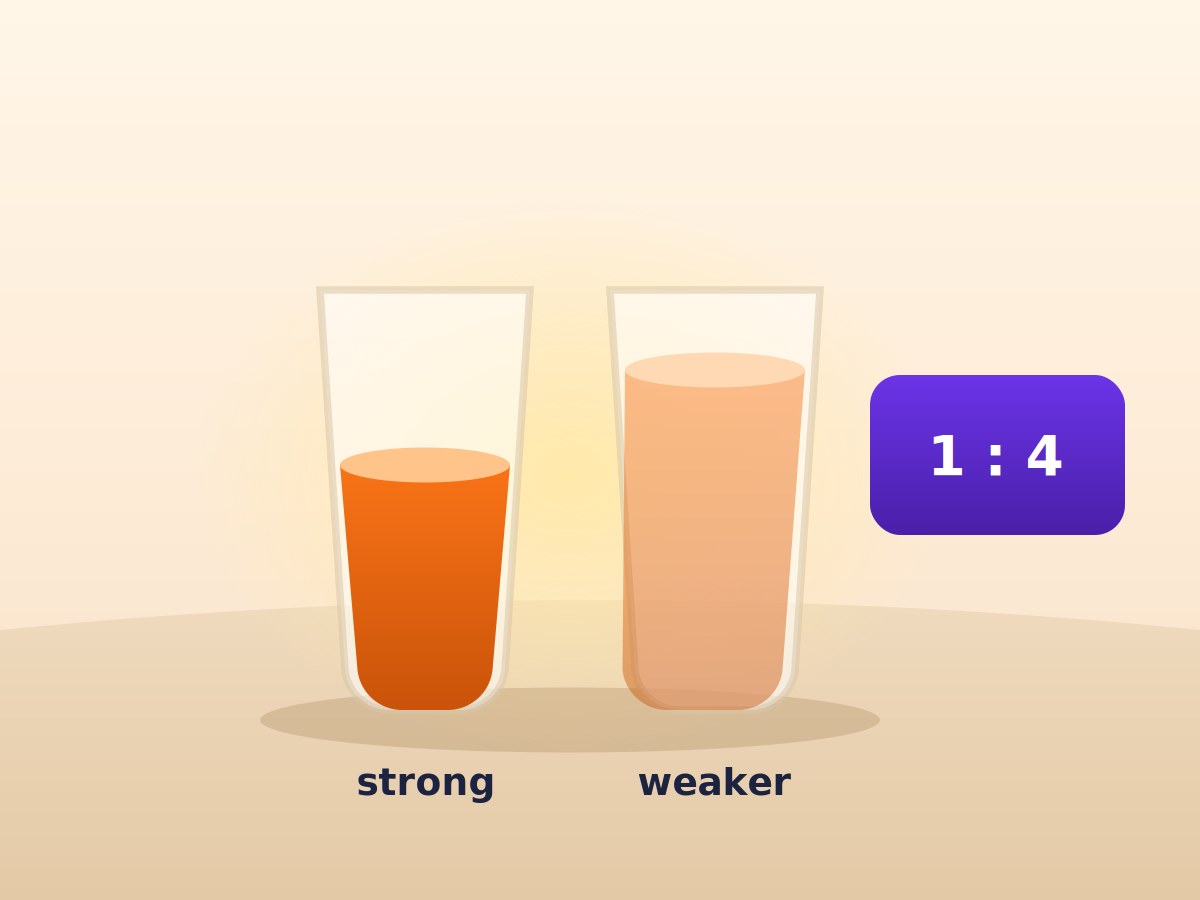
Ratio just compares amounts. If you double both, the drink tastes exactly the same.
Ratio has an intimidating name and a very ordinary meaning. Your child has been making ratios since the first time they were allowed near a bottle of squash.
That's where to start — not with the colon notation, and definitely not with a worksheet.
Start with squash
The perfect drink needs 1 part squash to 4 parts water. That's a ratio, written 1 : 4.
Now double it — 2 parts squash to 8 parts water. It tastes exactly the same, because the relationship between the two amounts hasn't changed. Only the quantity has.
That single observation is most of what ratio is.
Then make it something they can move
Put two red counters next to three blue ones. The ratio of red to blue is 2 : 3.
Ask: “if I doubled everything, what would I need?” Four red and six blue. Still equivalent.
Use a recipe you're actually cooking. If two people need one cup of rice and two cups of water, what do four people need?
“We're doubling the people. What has to happen to both numbers?”A kitchen is the best classroom there is for this, because getting it wrong has consequences you can taste.
The mistake children often make
Order matters, and it's the commonest lost mark in the topic. 2 : 3 does not mean the same thing as 3 : 2.
The habit that fixes it is saying what you're comparing, every time. Not “it's two to three” but “red to blue is two to three.”
Six extra words, and it removes most of the errors.
“A drink uses 1 part squash to 4 parts water. If we use 3 parts squash, how much water?”
Twelve. Then the half that matters: “how did you work that out?”
You're listening for “because I tripled the squash, so I have to triple the water.” That's proportional reasoning, and it's the thing Year 7 will keep asking for.
If they're still stuck
Go back to counters, or actual squash. Ratio falls apart quickly when it becomes abstract too early — most children who “can't do ratio” can do it perfectly well with objects on a table and lose it the moment it becomes a colon on a page.
More maths in the Learning Centre
Worked examples across the maths topics, building up to the Year 6 style of question — free to use at your child's pace.
Browse the free maths lessons →Where MindBlaze fits
Recipes and scaling are exactly the contexts the curriculum uses to introduce proportional relationships, which is why the kitchen version isn't a shortcut — it's the real thing.
MindBlaze keeps ratio in the daily rotation alongside fractions and percentages, because they're closer relatives than most children realise.

Same relationship. Different amount.