 Daily missions. Brighter futures.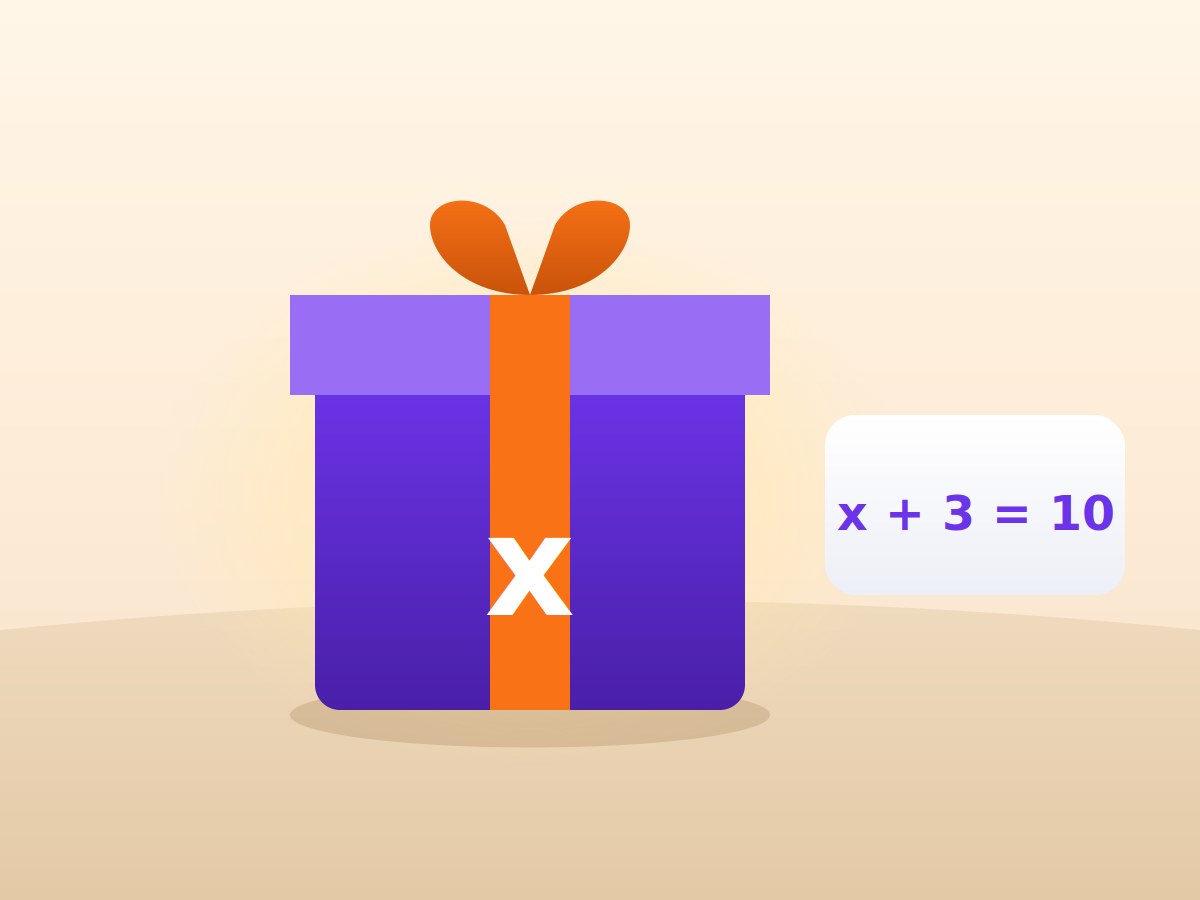
The letter is standing in for a number we don't know yet. That's the whole of it.
Why have they put letters in maths? Children ask it in a slightly outraged tone, and they have a point — nobody usually explains.
The answer is one sentence long, and once it lands, algebra stops looking like a new subject and starts looking like something they've been doing for years.
They've done this before
5 + ? = 12What's missing? Seven. Children have been answering that question since Year 2.
Now write it like this:
5 + x = 12Nothing important has changed. We swapped a question mark for a letter. The letter is just standing in for a number we don't know yet.
Make x a mystery box
x + 3 = 10. There's a number hiding in the box. What number plus three makes ten? Seven. So x = 7.Framed as a puzzle rather than a procedure, most children find this genuinely enjoyable — they're solving something, not applying something.
Three in a row, letting them work backwards each time:
x + 5 = 14 · 2 × x = 12 · x − 4 = 6Don't teach a rule about “doing the same to both sides” yet. Let them reason it out. The formal method lands much better later on top of an idea that already makes sense.
The mistake children often make
A lot of children assume x means multiply, because for five years that's exactly what it meant.
It's worth saying explicitly: × is the multiplication sign, x is a letter standing for an unknown, and you tell them apart from context. Slightly annoying, entirely survivable.
This is also why secondary maths starts using a dot or nothing at all for multiplication.
“If y + 6 = 15, what is y?”
Nine. Then: “how do you know?”
Changing the letter from x to y is a small but useful test. A child who has understood the idea doesn't blink. A child who has memorised “x is 7” from earlier gets stuck — which tells you exactly where to go back to.
Introduction to algebra
Missing numbers, simple formulae and number puzzles — the Year 6 route into algebra, which introduces letters through situations children already understand.
Open the Algebra lessons →Where MindBlaze fits
Algebra isn't replacing the maths your child already knows. It's giving them a shorter way to describe it — and that's a much less frightening sentence than most children are given.
MindBlaze introduces the same idea through puzzles in the daily missions, so the notation arrives after the reasoning rather than before it.

A mystery box with a number inside.