 Daily missions. Brighter futures.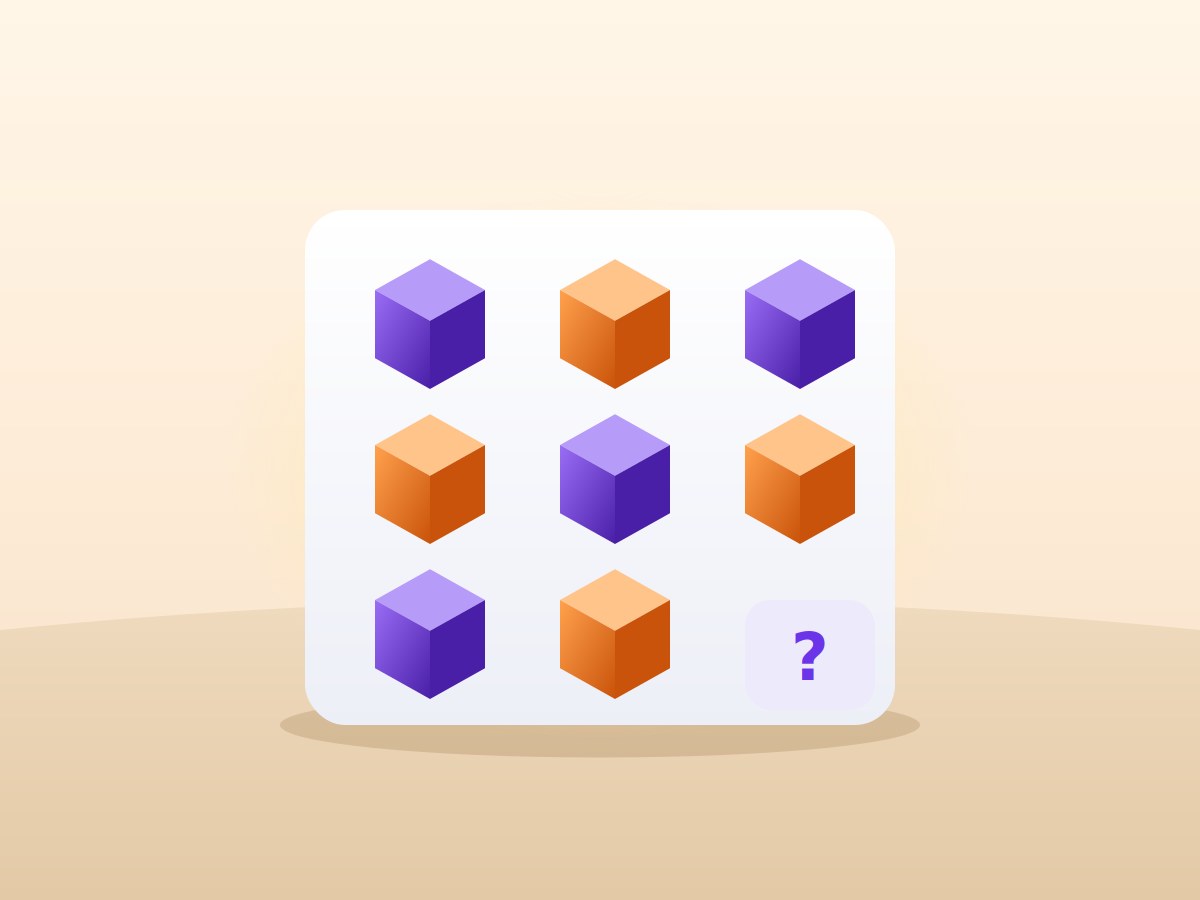
Don't stare at the whole puzzle. Find one thing that's changing, then look for another.
Shapes. Arrows. Dots. Rotations. One missing box and five options underneath. Non-verbal reasoning is the section most parents have genuinely never encountered, because it wasn't a thing when we were at school.
The reassuring part: the underlying question is nearly always the same, and it's very short.
The only question that matters
What's changing?That's it. Non-verbal reasoning asks children to spot patterns and relationships using shapes instead of words. Harder questions just change more than one thing at once.
Start somewhere obvious
One dot. Two dots. Three dots. What comes next?
Four. Your child just spotted a rule — add one each time — and stated it. That's precisely what the difficult questions want, only with three rules running together instead of one.
Six things to look for
When a pattern looks like noise, run down the list rather than staring harder:
Is something rotating? Being added? Disappearing? Changing colour? Changing position? Changing number?Six checks, in order. Most questions surrender to the first two.
Draw three arrows: ↑ → ↓
Ask what comes next. (←, rotating ninety degrees clockwise each time.)
Then: “what was the pattern?” Saying the rule out loud is the practice — the arrow is just the excuse.
The mistake children often make
They look at the whole grid at once, find it overwhelming, and freeze. Then they guess, because guessing feels better than staring.
Break it up with a much smaller question: “what's one thing you notice changing?”
Find one rule. Then go looking for another. Complicated puzzles are simple rules stacked up, and they come apart one layer at a time.
“What was the pattern?”
Don't stop when they pick an answer — that's where most practice goes wrong, because a lucky guess and genuine understanding look identical on a multiple-choice page.
A guess can't explain itself. Understanding can, and it'll still be there next month.
The habit you're building is four words long: look, compare, spot the change, test the rule.
Non-verbal reasoning in MindBlaze
Sequences, matrices, rotation, reflection, odd-one-out and nets — each question type explained, then practised.
Open the NVR lessons →Where MindBlaze fits
Non-verbal reasoning is often where children who find words or numbers difficult discover they're rather good at something — which is worth knowing if your child has decided they're “not clever”.
MindBlaze includes it in the daily missions for that reason as much as for exam preparation.

Look. Compare. Spot the change.