 Daily missions. Brighter futures.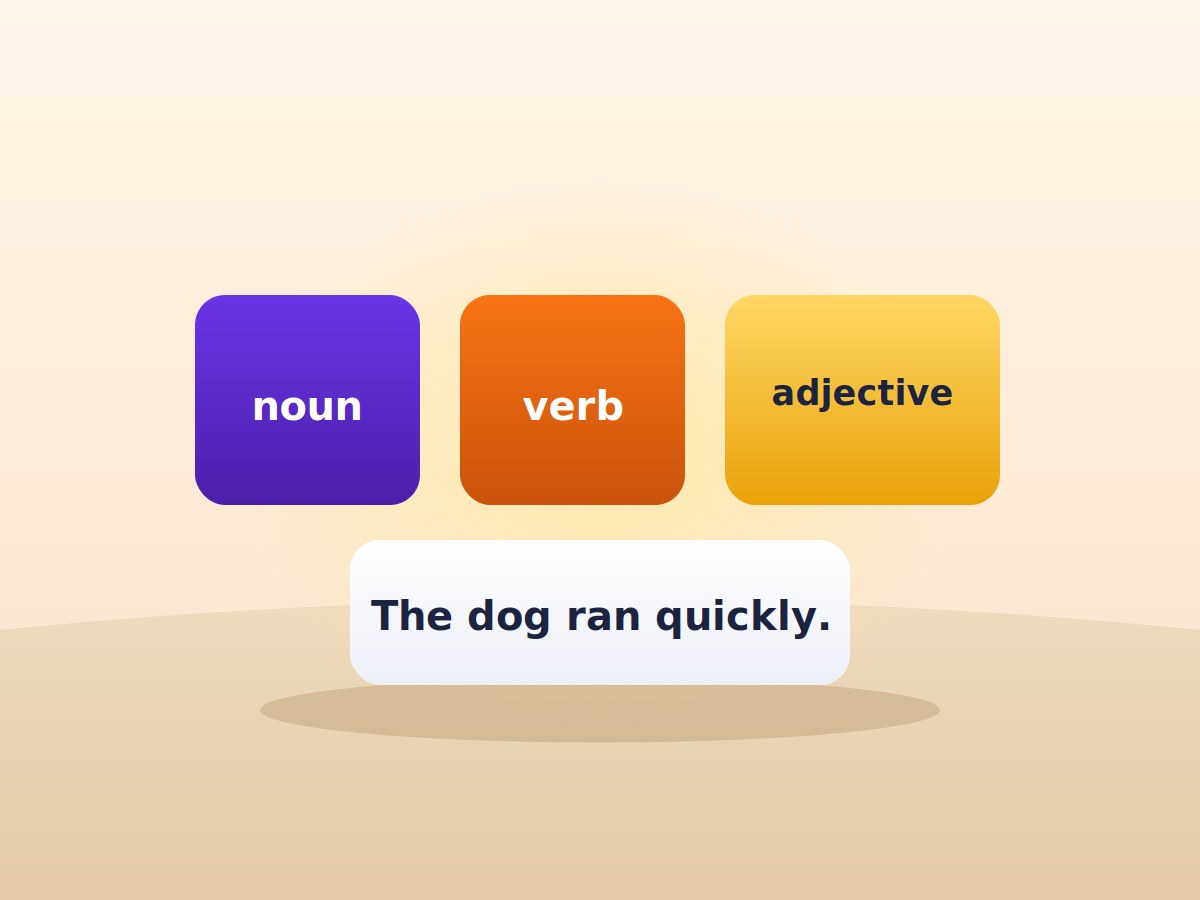
Labels describe the job a word is doing. Which is why you can't identify one without looking at the sentence.
If noun, verb, adjective, adverb have become a bit hazy since you were at school, you are in enormous company — and your child's homework is about to test both of you.
Here's the version that's actually useful at a kitchen table.
The four, in one line each
Noun — the thing. A person, place or object. dog, school, London, teacher.Verb — what's happening. The action or state. ran, jumped, laughed, is.Adjective — describes a noun. enormous dog, red car, cold morning.Adverb — usually tells you how the action happened. ran quickly, spoke quietly, waited patiently.Then build a sentence out of them
Start with The dog ran. Noun: dog. Verb: ran.
Add an adjective: The enormous dog ran. Add an adverb: The enormous dog ran quickly.
Now the labels aren't vocabulary to memorise — they're names for jobs your child can see being done.
Open any book at any page and pick one sentence.
“Find me one noun.” “What's happening?” “Which word gives us more detail?”Three questions, one sentence, under two minutes — and it works with a novel, a cereal packet or a road sign.
The mistake children often make
They try to identify a word on its own, as though each word has one permanent label. Plenty don't.
Run is a verb in “I run home” and a noun in “I went for a run”. Fast is an adjective in “a fast car” and an adverb in “he ran fast”.So the rule is: always look at the sentence. The label describes the job the word is doing right there, not what the word is.
“The excited puppy barked loudly.”
Noun: puppy. Verb: barked. Adjective: excited. Adverb: loudly.
Then the question that separates knowing from labelling: “what job is each word doing?”
A child who can say “excited tells you what the puppy was like, loudly tells you how it barked” understands grammar. A child who can only produce the four labels has memorised a list.
English in the Learning Centre
Word classes explained through sentences rather than definitions, plus the terms Year 6 is expected to know.
Browse the free English lessons →Where MindBlaze fits
Grammar gets much easier when children understand what words do rather than memorising what they're called — and much harder when it's taught the other way round.
MindBlaze's English challenges use grammar in context rather than as a naming test.

The label describes the job.